Concrete Sidewalk Replacement in Kansas City: When to Replace vs Repair
Everything you need to know about concrete sidewalk contractors kansas cityfrom Kansas City's trusted concrete experts.
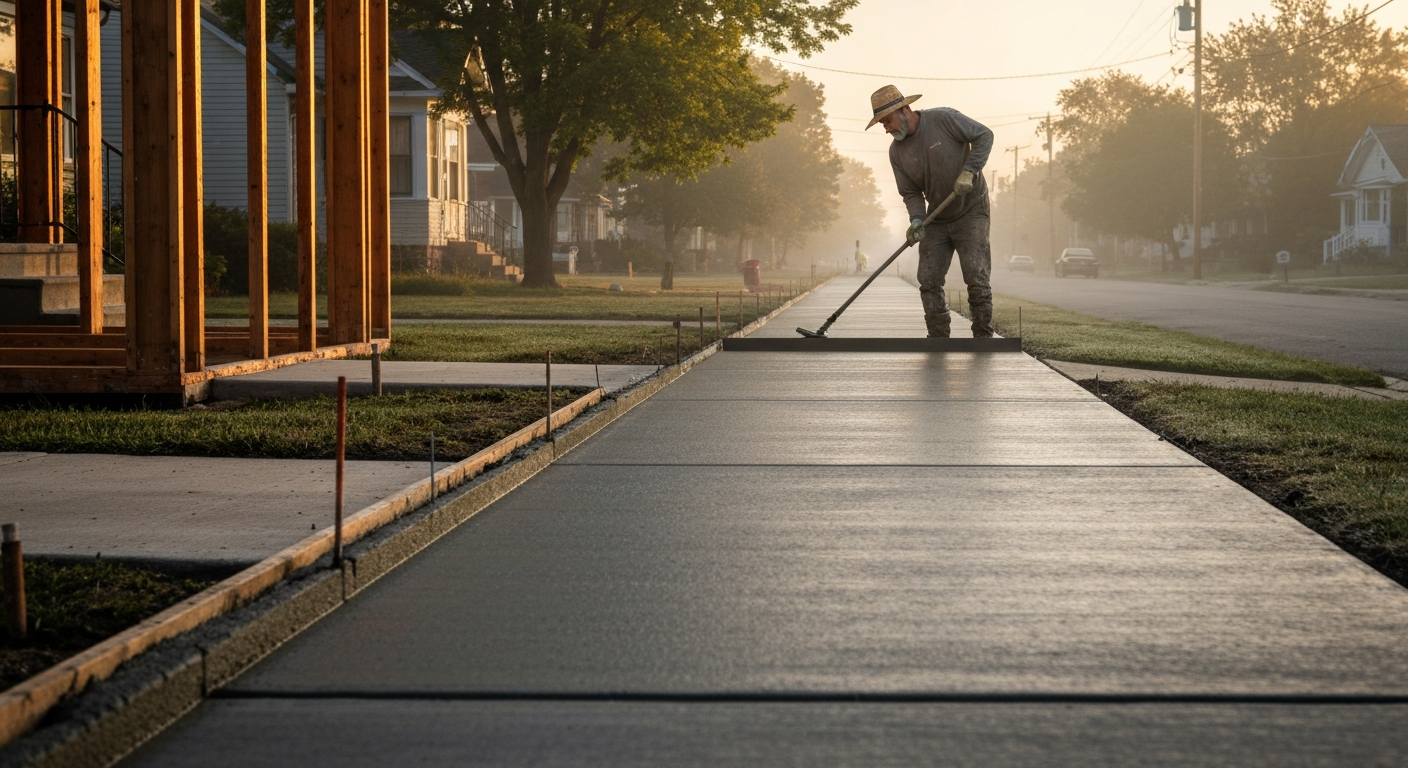
Kansas City's residential sidewalks take a beating. The combination of freeze-thaw cycles, mature tree root systems, and aging concrete stock from the 1960s–1990s means that cracked, heaved, and sunken sidewalk sections are common across neighborhoods from Waldo to Leawood. The question most homeowners face isn't whether the sidewalk needs attention — it's whether repair is viable or whether full replacement is the smarter investment. This guide covers the repair-versus-replace decision, city versus homeowner responsibility in Kansas City, what the replacement process looks like, and what it should cost in 2026.
Repair vs. Replace: How to Make the Right Call
Not every sidewalk problem requires full replacement. Hairline cracks less than 1/8 inch wide with no displacement are normal shrinkage cracks — fill with a flexible polyurethane crack filler, a DIY-viable repair that buys years of additional service life. Cracks 1/4 inch or wider with vertical displacement indicate structural movement. If displacement is 1/2 inch or less, grinding can restore trip-hazard compliance affordably. Displacement greater than 1/2 inch, widespread cracking across a section, surface scaling or spalling, or sections that are rocking or hollow-sounding underfoot all indicate the section needs replacement. Replacing individual sections is standard practice — you don't need to replace the entire sidewalk run unless the whole thing is failing.
City vs. Homeowner Responsibility in Kansas City
In Kansas City, Missouri, the sidewalk in front of your home is generally your responsibility to maintain, even though it sits in the public right-of-way. This means crack sealing, panel replacement, and trip hazard repair are on the homeowner. The City of KCMO conducts periodic sidewalk inspection programs and may issue notice of violation requiring repair within a specific timeframe — these notices carry fines for non-compliance. In Kansas cities (Overland Park, Olathe, Shawnee, Lenexa), the same general rule applies — the adjacent property owner is responsible for sidewalk maintenance. If you're uncertain about responsibility for a specific stretch, your city's public works department can clarify. If your sidewalk was damaged by a city utility project, you may have a claim for repair reimbursement.
The Replacement Process: Permit, Demo, Pour, Cure
Most KC-area cities require a permit for sidewalk replacement in the public right-of-way. Permit fees are modest ($30–$100 typically) and your contractor should handle the filing. Demo: the failing section is saw-cut at the joint lines, broken up, and hauled away. The subbase is assessed — if tree roots are the issue, they're cut back and treated. A 4-inch compacted gravel base is installed. Pour: residential sidewalks are typically poured at 4 inches of 4,000 PSI concrete, with control joints scored or saw-cut every 4–5 feet. Broom finish is standard. After the pour, the section needs 24–48 hours before foot traffic and 7 days before any vehicle crossing.
Cost: Section Pricing and Per-Square-Foot Rates
Kansas City sidewalk replacement costs $8–$14 per square foot for standard concrete in 2026. Individual section replacement (a standard 4x4-foot panel) costs $175–$350 per section. Most contractors have a minimum project size; for single-section repairs, expect to pay $300–$500 all-in. Longer runs of replacement (10–30 feet of continuous sidewalk) are more cost-efficient, running closer to $8–$10/sq ft. Factors that push costs up include tree root removal, concrete disposal, re-establishing grade after root excavation, or working in tight conditions. If your sidewalk has multiple failing sections along a continuous run, doing them all at once in a single mobilization saves significantly over addressing them one at a time.
Tree Roots: The #1 Cause of Sidewalk Failure in KC
Mature tree roots — oaks, maples, elms, and sweetgums — are responsible for the majority of heaved and cracked residential sidewalks in Kansas City's established neighborhoods. Roots grow toward moisture and seek out the edges and joints of concrete slabs. Once a root finds its way under a panel, it grows and exerts upward pressure that lifts the concrete within 5–10 years. Approaches when tree roots are involved: root pruning cuts roots back but they regrow. Deeper replacement with root barriers installed along the sidewalk's edge offers longer protection. In some cases, the panel should be poured slightly thicker (5 inches) to compensate for the compromised subbase. City-owned trees in the right-of-way may be the city's responsibility to manage — contact your public works department if the tree causing damage is in the city-owned tree belt between the sidewalk and the curb.
ADA Compliance: When Repairs Trigger Upgrades
If you're replacing a sidewalk section that connects to or includes a curb ramp, the ramp must meet current ADA standards after the replacement — even if the original ramp was non-compliant. This includes minimum width (5 feet), slope requirements (1:12 maximum running slope), and detectable warning surface requirements (the bumped yellow pads at ramp bases). City inspectors in KCMO and most Johnson County cities flag non-compliant ramps during permitted sidewalk projects. Your contractor should be aware of these requirements and factor ramp upgrades into the scope when applicable. KC Concrete Guide connects Kansas City homeowners with sidewalk replacement contractors who know local permit requirements and ADA standards across both sides of the metro — submit a request to get a free, no-obligation estimate.
Repair vs. Replace: Making the Right Call
Not every damaged sidewalk needs full replacement — but knowing the difference saves you from both overpaying and underinvesting. Here's the decision framework used by experienced KC concrete contractors: Hairline cracks (less than 1/8" wide, no vertical displacement) — seal with polyurethane caulk and monitor. These are usually shrinkage cracks from curing and don't indicate structural failure. Vertical displacement less than 1/2" (one panel higher than adjacent) — grinding (slab grinding) is the repair. A diamond grinder levels the raised edge, typically costing $50-$150 per trip hazard location. Vertical displacement over 1/2", or any horizontal cracking across the full width of a panel — replace the panel. Grinding won't solve the underlying problem (usually root heaving or soil settlement) and the panel will continue to deteriorate. Crumbling, spalling, or scaling surface — if it covers more than 20-30% of a panel, replace. Surface patching has a poor track record on freeze-thaw climate sidewalks; the patch bonds to a deteriorating substrate and fails within 2-3 KC winters. Widespread cracking across multiple panels, significant settlement, or any panel where the subgrade has washed out — full replacement is the right call. Trying to repair widespread failure is false economy.
Who's Responsible for Kansas City Sidewalks
This trips up KC homeowners every time: in Kansas City, Missouri (and most KC metro municipalities), the homeowner is responsible for maintaining the public sidewalk in front of their property — even though it's technically in the public right-of-way. The city owns the infrastructure; you maintain it. If a pedestrian trips on your failed sidewalk and is injured, you can be held liable. Kansas City MO has a sidewalk repair program where the city will sometimes share repair costs with homeowners — worth checking at kcmo.gov before paying full price. In Overland Park and Olathe, similar responsibility rules apply; check your specific municipality's code. The practical implication: don't ignore a tripping hazard on the strip of sidewalk between your yard and the street. It's your sidewalk to maintain, your liability if it hurts someone, and your cost to replace it.
Tree Roots: The #1 Cause of KC Sidewalk Damage
Kansas City's mature tree canopy — one of the densest urban forests in the Midwest — is beautiful and a liability to concrete. Surface roots from silver maples, cottonwoods, and other fast-growing species common in KC's older neighborhoods can lift a 4-inch concrete panel by 6+ inches over 10-15 years. When roots cause sidewalk heaving, you have several options, each with trade-offs: Root pruning and replacement — cut the offending root 12-18 inches below grade, replace the panel with a root barrier (a physical or chemical deterrent installed in the soil). This buys 5-15 years before roots return, depending on tree species. This option is only viable if the tree can tolerate root pruning without destabilizing — consult an arborist for trees over 12" trunk diameter. Ramped replacement — pour a new panel with a gradual slope that accommodates the raised root zone. This is a compromise option for smaller heave and when tree preservation is the priority. Root deflectors — rigid plastic panels installed vertically around the root zone to redirect future growth downward. Most effective when installed at time of new sidewalk installation. Tree removal and replacement — the permanent solution when the tree is causing repeated damage, is diseased, or is species that will continue aggressive surface rooting. An arborist assessment should happen before and after any sidewalk work that involves cutting significant roots.
The Sidewalk Replacement Process: What to Expect
A standard concrete sidewalk replacement in KC follows this sequence: Panel marking — the contractor walks the sidewalk and marks panels for replacement with spray paint. This is your chance to walk with them and understand exactly what's being replaced and why. Permit — some municipalities require a permit for sidewalk work in the public right-of-way; your contractor handles this. Demo — individual panels are broken out with a jackhammer and hauled away. Base inspection — once demo'd, the subgrade is inspected. If soil has washed out or roots have left voids, they must be filled with compacted gravel before pouring. This is where estimates sometimes increase; it's legitimate if the subgrade needs work. Pour — new 4-inch concrete (3,500-4,000 PSI minimum) is poured to match the width and slope of existing sidewalk. Control joints are tooled at panel spacing consistent with existing sections. Finish — broom finish is standard for public sidewalks; some municipalities require specific finishes to match neighborhood standards. Cure — 24-48 hours before foot traffic; 7 days before any vehicle rolls over it (if sidewalk crosses a driveway apron). Typical completion time: 1 panel can be done in half a day; a 10-panel replacement takes 1-2 days.
Sidewalk Replacement Cost in Kansas City
Sidewalk pricing in KC is typically quoted per linear foot (running along the length of the sidewalk) or per panel (individual 5-ft sections). Here's what to budget in 2026: Per panel (5 ft x 5 ft = 25 sq ft): $250-$450 per panel including demo and haul-away. Per linear foot (standard 5-ft wide sidewalk): $50-$90 per linear foot. A 50-foot run of sidewalk costs $2,500-$4,500. Per square foot: $10-$18 depending on conditions. What pushes cost higher: multiple root removal requirements, subgrade issues requiring import fill, work in tight urban lots, permit requirements, any panel that requires step-up or transition sections. What keeps cost lower: straightforward replacement, no root issues, easy equipment access, multiple panels in a single run (mobilization cost is shared). ADA compliance: if your project involves a corner or driveway apron intersection, current ADA requires detectable warning surfaces (truncated dome panels) at curb ramps. This adds $150-$400 per location but is required by law on public sidewalks. KC Concrete Guide matches KC homeowners with sidewalk contractors for free. Fill out a quote request and we'll connect you with a licensed local contractor who can assess your specific situation.
KC Concrete Guide Editorial Team
Expert guides on concrete services, costs, and contractor selection for Kansas City homeowners. Our team researches local market pricing, contractor standards, and regional considerations to help KC homeowners make informed decisions.
Related Articles
Concrete Sidewalk Contractors in Kansas City
Repair vs. replace, city responsibility rules, tree root damage, and what KC sidewalk work costs in 2026.
Read more Hiring GuideHow to Choose a Concrete Contractor in Kansas City
What to verify, what to ask, and the red flags that should end the conversation.
Read more Cost GuideConcrete Driveway Cost in Kansas City (2026)
What does a new concrete driveway actually cost in Kansas City? Price ranges by finish type, size, and site conditions.
Read moreReady to Start Your Project?
Get connected with vetted Kansas City concrete contractors today.
Get a Free Quote