Does Concrete Leveling Last? Mudjacking vs. Polyjacking in Kansas City
Practical advice for Kansas City homeowners comparing concrete contractors.
A plain-English guide for homeowners with a sunken driveway, sidewalk or patio.
Last updated: November 2, 2026
Short answer: concrete leveling lifts a settled slab, but it does not fix the reason the slab sank. How long a lift lasts depends mostly on that cause - washed-out soil, poorly compacted fill, or clay that swells and shrinks. Angi says mudjacking lasts "five to 10 years or more" and that polyjacking generally lasts longer. The American Concrete Institute (ACI) says slabjacking "will level the slab, but it won't correct any underlying poor soil conditions." Fix the cause (usually water) and a lift can hold for years; ignore it and the slab can sink again.
If you already know you need a lift and want a contractor, go to our concrete leveling service page. If you are still deciding what to do, keep reading.
What "concrete leveling" means (and why it has so many names)
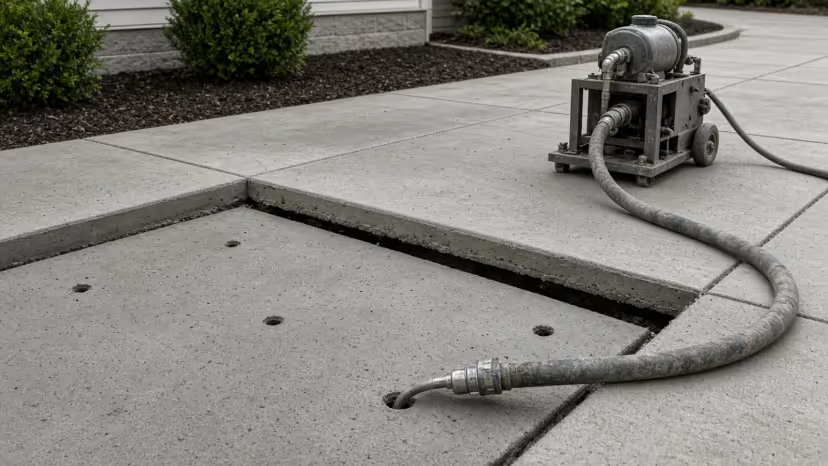
Mudjacking, slabjacking, concrete lifting, concrete raising, foam lifting and polyjacking all describe one idea. ACI defines slabjacking as "raising concrete pavement slabs or filling voids under them, or both, by injecting a material (cementitious, noncementitious, or asphaltic) under pressure." A crew drills holes through the slab, pumps material underneath, and the slab rises. The holes are then filled.
The two methods you will be quoted:
- Mudjacking pumps a cement-based slurry. Angi describes the slurry as a mix of soil, clay, sand, limestone and cement that varies with the job and local climate.
- Polyjacking (foam lifting, polyurethane lifting) injects expanding polyurethane foam.
Mudjacking vs. polyjacking at a glance
| Mudjacking (slurry) | Polyjacking (polyurethane foam) | |
|---|---|---|
| What goes under the slab | Cement-based slurry | Expanding polyurethane foam |
| Hole size | ACI: 1 1/2 to 2 1/2 in. Angi: about 2 in. | ACI: 1/2 to 3/4 in. Angi: about the size of a dime |
| Weight on the soil | Heavier. ACI notes the added grout weight "may cause additional soil settlement" | Lighter. Angi: less pressure on the soil underneath |
| Wait before use | Angi: 24 to 48 hours to cure | Angi: about 15 minutes to cure |
| Where Angi says it fits | Larger jobs, driveways and other heavy areas, non-structural slabs (sidewalks, patios, pool decks, driveways) | Smaller slabs, highly visible areas, areas that need precise lifts; Angi's cost guide calls it overkill for sidewalks and patios but one of the more permanent options for driveways and foundations |
| Known drawbacks | Larger holes can crack smaller slabs (Angi); can erode or settle over time (Angi); does not stabilize soil | Foam can set before filling every void and can overlift if too much is injected before it expands (Angi); ACI notes the cavity under the slab "frequently is not completely filled" |
| Price, national | $3-$6 per sq ft (Angi) | $5-$25 per sq ft (Angi) |
Prices in the table are Angi's national ranges. See how they compare with tear-out and replacement in our driveway cost guide. Angi's own pages do not always agree with each other on which method fits which slab (one says mudjacking is best for driveways, another says polyjacking is one of the more permanent options for driveways), so ask any contractor why they recommend their method for your slab.
What the engineering research says
We found no neutral long-term comparison for residential driveways. The studies below are on highway slabs and bridge approach slabs, so treat them as background, not a forecast for your driveway:
- Missouri DOT's engineering policy guide says grout "is better for void-filling under slabs and stabilization at lower cost" and polyurethane "is better for lifting slabs at higher cost," and that combining them can be cost effective for bridge approach slabs.
- A federal pooled-fund field study (Pennsylvania US 422) found both cementitious grout and polyurethane foam improved support near cracks and joints, but not mid-panel. The foam did not fully penetrate the stone base layer, creating uneven support, and slab movement during injection exceeded the project's 1.3 mm allowance, so the authors called for better control of lift.
- An Oregon DOT study monitored polyurethane-injected slabs for two years. They settled by up to 10.5 mm (0.41 in), and the foam's compressive strength was not reduced by underground exposure.
Takeaway: neither material is magic. Both depend on the soil and on the crew's control of the lift.
Does concrete leveling last?
It depends on why the slab sank. According to ACI, slabs settle from "improper soil compaction, shrinkage of the soil (such as from drying out), or erosion of the sub-base." If that process is still going, "it may be necessary to repeat the slabjacking one or more times," and a slab that keeps sinking after a lift probably sits on poorly compacted fill, subsurface erosion, or continuing soil shrinkage.
What the sources say affects how long it lasts:
- The soil. Angi: soil with high clay content, loose soil or shifting soil can shorten how long mudjacking lasts.
- Water and drainage. Angi calls erosion "a major contributing factor" and recommends redirecting drainage after the lift so water doesn't wash soil from under the slab.
- Freeze-thaw. Angi lists freeze/thaw expansion and contraction under the slab as a factor that shortens how long mudjacking lasts.
- The material. Angi says mudjacking "can last five to 10 years or more" and can even last several decades in ideal conditions, and that it often doesn't last as long as other methods. Angi says polyjacking foam is "moisture-resistant" and stays lifted for a long period, but gives no number. One equipment and contractor FAQ (HMI) claims 20 years or more for polyurethane and 5-10 years for mudjacking; that is a vendor claim, not an independent study.
- The warranty. Angi notes mudjacking warranties "may only extend for one or two years" and coverage may be limited. Ask for terms in writing and ask what the warranty excludes (for example, new settlement from drainage that was not corrected).
Why Kansas City clay matters
The Johnson County Building Officials Association's Residential Foundation Guideline describes "a predominance of clay soils with varying expansive characteristics" and warns that placing floor slabs "on dried and shrinking clay soils may cause cracks and heaving after the soil returns to normal moisture content." That guideline is written for new foundations and floor slabs, but it shows the same swelling and shrinking clay is recognized as a local movement problem. It is one reason a leveled slab may need follow-up.
Make a lift last: a short checklist
- Send roof water away from the slab (downspout extensions, grading that slopes away).
- Ask the contractor what they think caused the settlement and how they checked (a washed-out joint, a leaking line, trench backfill, poor fill).
- Fill joint and crack openings so water does not run under the slab again (Angi lists crack sealing and drainage improvements as items to budget for).
- Watch tree roots and burrowing animals near the slab (Angi).
- Re-check for new cracks or shifting after the first freeze-thaw winter (Angi recommends regular inspection).
Level or replace?
Both ACI and Angi say replacement should be considered, not assumed. ACI: "Slab removal and replacement should be evaluated as an alternative to slabjacking, depending on the current slab cracking, distress, and anticipated future movements." Angi: if the slab's structural integrity is compromised or it is too damaged to level properly, replacement may be better.
| Points toward leveling | Points toward replacing |
|---|---|
| The slab is in one piece or a few large pieces and the surface is sound | The slab is broken into many pieces, crumbling, scaling or has exposed rebar |
| The cause is known and fixable (downspout, washout, trench settlement) | Settlement keeps recurring or the cause cannot be corrected |
| A trip lip or a dip that holds water, with the rest of the slab in good shape | Settlement is deep; contractor guides use roughly 4 to 6 inches as the point where replacement is usually considered |
| Cracks are narrow and the panels are not offset | Wide cracks and one side much higher than the other (Angi lists cracks over 1/4 inch as a sign a slab needs attention; contractor guides treat wide, offset cracks as a replacement sign) |
| You want to keep the same size, layout and finish | You want to change the size, slope, thickness or finish, which means pouring new |
Notes: the 4-6 inch figure and the crack-width guidance come from contractor guides (Projul, Seattle Concrete), not a standard or code, so treat them as rules of thumb and get a site assessment. Where one or two panels are shot and the rest are sound, contractor guides describe lifting the sound panels and replacing only the broken ones.
Cost can help the decision. ACI says slabjacking "is often less than half" the cost of constructing a new slab, and Angi says leveling is less than half the price of replacing sidewalks, patios, walkways and pool decks. As a rough yardstick, Angi's national figures are $3-$6 per sq ft for mudjacking, $5-$25 for polyjacking, $1-$5 for crack and surface repair, and $2-$6 per sq ft just to tear out a slab; a two-car gray driveway replacement with tear-out works out to roughly $4,000-$10,800 (our arithmetic). Every one of those is explained and sourced in our driveway cost guide. If leveling plus crack repair starts to approach a replacement quote, replacement may be the better spend.
Related options: concrete repair for cracks and edges, concrete resurfacing for a worn surface (ACI also lists a polymer-modified topping as one way to improve the look of a slab after the grout holes are patched), and concrete replacement when the slab is past saving.
What is being leveled: driveways, sidewalks and patios
- Driveways. A panel near the garage or street apron often drops first. The driveway cost guide covers replacement ranges and city permit rules for the part of the driveway in the public right-of-way. See our driveway service.
- Sidewalks and walkways. The usual job is a trip lip between two squares, which is a single panel, not the whole walk. See sidewalks.
- Patios, steps and porches. Angi lists patios and pool decks among typical mudjacking jobs. Stamped or colored slabs: ACI warns that grout holes will be visible and suggests resurfacing as one way to improve the finish, so ask how the contractor will patch the holes and match the surface.
Concrete leveling near me: how to find and compare a company
Search results for "concrete leveling near me," "mudjacking near me" and "concrete lifting near me" are mostly contractor pages. Whichever company you call, Angi's advice is to get at least three estimates, expect an in-person estimate before a method is recommended, and bring photos and the square footage of the uneven area. Compare:
- Method and why. Slurry or foam, and the reason for your slab and soil.
- Cause of the settlement. What they found and what drainage or soil fix they recommend. ACI says soil conditions should be determined before slabjacking.
- Hole size and finish. How many holes, what size, and how they will be patched.
- Utilities. ACI warns the grout "will follow the course of least resistance" and can unintentionally fill sewers, utility lines or drains, so ask how they locate them.
- Cure time and when you can drive on it. Angi: 24-48 hours for slurry, about 15 minutes for foam.
- Warranty. In writing, with exclusions.
- Winter. Angi advises against mudjacking unless the ground stays above freezing; ACI says slabjacking can be done in virtually any weather, so ask what the contractor does in cold weather.
Ready to talk to a contractor? Request a quote on our concrete leveling page, or start with your city: Olathe | Overland Park | Lenexa | Shawnee | Lee's Summit | Kansas City.
Frequently Asked Questions
Does mudjacking last?
Angi says mudjacking can last five to 10 years or more, and several decades in ideal conditions. It depends on the soil, drainage, freeze-thaw and the mix. ACI cautions that the lift does not correct poor soil, and a slab that is still settling may need to be lifted again.
How long does polyjacking last?
Angi describes polyurethane foam as moisture-resistant and longer-lasting than slurry but gives no number. One contractor FAQ claims 20 years or more (a vendor claim). An Oregon DOT study of injected highway slabs found up to 10.5 mm of settlement over two years, so foam is not immune to a soil that keeps moving.
What is the difference between mudjacking and polyjacking?
Mudjacking pumps a heavier cement slurry through larger holes and takes 24 to 48 hours to cure (Angi). Polyjacking injects lighter polyurethane foam through holes about the size of a dime and cures in about 15 minutes (Angi). Foam costs more per square foot (national Angi ranges are in the table above and in the cost guide).
Which is better, mudjacking or polyjacking?
It depends on the slab, the soil and the budget. Angi says polyjacking is often considered better because the foam is lighter and puts less pressure on soil, while mudjacking costs less and is common on driveways, sidewalks and patios. Ask the contractor to explain their recommendation.
Can concrete be leveled if it keeps sinking?
It can be lifted again, but ACI says if the concrete keeps sinking there is "a very good possibility" it sits on poorly compacted fill, subsurface erosion or shrinking soil. Fix the cause first.
When should I replace instead of level?
When the slab is broken up, crumbling or heavily scaled, when the cause of settlement cannot be fixed, or when leveling plus repairs approaches the cost of replacement. See the table above and concrete replacement.
Can you level concrete in winter?
Angi says it is best not to mudjack in winter unless the ground stays above freezing. ACI says slabjacking can be done in virtually any weather. Ask how your contractor handles cold weather.
How much does concrete leveling cost in Kansas City?
Angi's national ranges are $3-$6 per sq ft for mudjacking and $5-$25 per sq ft for polyjacking. We do not have an independent Kansas City leveling price; get a written site quote. See the cost guide for how these compare with replacement.
Where can I find mudjacking or concrete leveling near me?
Use our concrete leveling page to request a quote, or your city page above.
Sources
- American Concrete Institute, ACI RAP Bulletin 11, "Slabjacking" (2010): https://www.concrete.org/Portals/0/Files/PDF/RAP-11.pdf
- Angi, "Mudjacking vs. Polyjacking: What's the Difference?" (updated Jul 9, 2026): https://www.angi.com/articles/mudjacking-vs-polyjacking.htm
- Angi, "How Long Does Mudjacking Last?" (updated Jul 9, 2026): https://www.angi.com/articles/how-long-mudjacking-lasts.htm
- Angi, "How Much Does Concrete Leveling Cost? [2026 Data]" (updated Sep 4, 2026): https://www.angi.com/articles/concrete-leveling-cost.htm
- Missouri DOT Engineering Policy Guide 771.1, slab stabilization (jacking): https://epg.modot.org/index.php/771.1_Concrete_Bridge_Approach_Slab_Repair:_Slab_Stabilization_(Jacking)
- FHWA/Iowa State, "Improving the Foundation Layers for Concrete Pavements ... Pennsylvania US 422 Field Study" (TPF-5(183)): https://www.intrans.iastate.edu/wp-content/uploads/2018/07/improving_foundation_layers_PA_US_422_w_cvr.pdf
- Oregon DOT, "Injected polyurethane slab jacking: final report": https://rosap.ntl.bts.gov/view/dot/22955
- Johnson County Building Officials Association, Residential Foundation Guideline: https://cdnsm5-hosted.civiclive.com/UserFiles/Servers/Server_8941388/File/Departments%20&%20Services/Community%20Development/Codes/residential_foundation.pdf
- Contractor guidance (labeled as such): Projul, "Mudjacking and Slab Leveling Guide for Contractors": https://projul.com/blog/construction-mudjacking-slab-leveling-guide/ ; Seattle Concrete, "Concrete Leveling vs. Replacement": https://seattleconcrete.com/blog/concrete-leveling-cost-vs-replacement ; HMI FAQ (vendor): https://hmicompany.com/about-us/frequently-asked-questions/
- KC Concrete Guide, driveway cost guide (reconciled, labeled figures): /blog/concrete-driveway-cost-kansas-city
KC Concrete Guide Editorial Team
Expert guides on concrete services, costs, and contractor selection for Kansas City homeowners. Our team researches local market pricing, contractor standards, and regional considerations to help KC homeowners make informed decisions.
Related Articles
Concrete Driveway Cost in Kansas City (2026)
What does a new concrete driveway actually cost in Kansas City? Price ranges by finish type, size, and site conditions.
Read more Sidewalk GuideConcrete Sidewalk Contractors in Kansas City
Repair vs. replace, city responsibility rules, tree root damage, and what KC sidewalk work costs in 2026.
Read more Hiring GuideHow to Choose a Concrete Contractor in Kansas City
What to verify, what to ask, and the red flags that should end the conversation.
Read moreGet a free quote
Send your project details and we will connect you with a vetted local concrete contractor. Free for homeowners.