Stamped Concrete Patio Ideas: Choose the Layout Before the Pattern
Practical advice for Kansas City homeowners comparing concrete contractors.
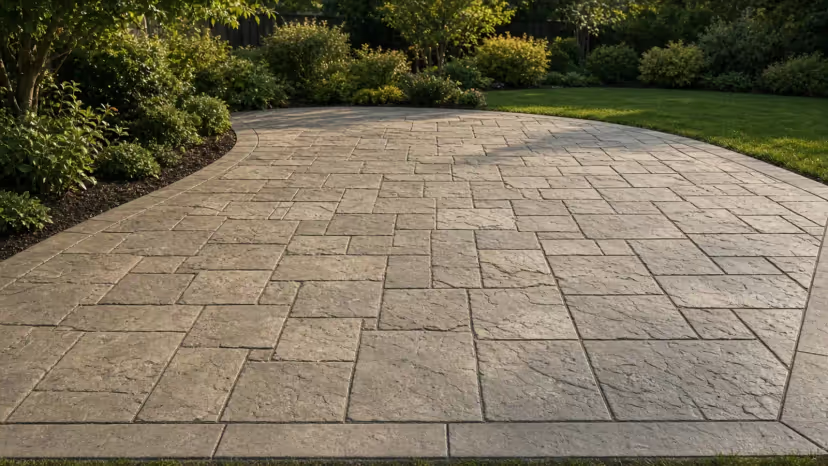
A patio can look impressive in a close-up photograph and still be awkward to use. Before choosing ashlar slate or a brick pattern, draw the table, chairs, grill, door swing, and routes across the space. Then choose a pattern and border that work with that layout.
This guide compares design choices. It does not claim to know the most popular pattern in Kansas City or promise that a stamped patio costs a fixed fraction of natural stone. For sourced budgeting, use the stamped concrete patio cost guide. For installation planning, see stamped concrete services and concrete patio services.
1. Ashlar slate for a structured field
Ashlar patterns combine rectangular or square stone shapes. Concrete Network's published pattern guide illustrates ashlar slate alongside brick, wood, cobblestone, and seamless textures. Use it to understand pattern families, not as evidence of local installation popularity.
An ashlar-style field is a design option when you want visible stone shapes without using actual individual pavers. Ask the installer to show the stamp available for your job and how its scale looks across the full patio. A small sample may not reveal repetition or the effect of the pattern at a narrow edge.
Design brief: identify the viewing direction from the main door, decide whether a separate border is needed, and ask how the pattern will meet any steps or adjoining walk. Request a joint drawing at the same time.
2. Brick patterns for a deliberate direction
Running-bond and herringbone are different visual choices. Running bond gives a repeated rectangular rhythm; herringbone creates a more directional, interlocking-looking pattern. In stamped concrete these are impressions in a slab, not separate bricks.
Consider this option when you want the patio to echo an existing brick accent without pretending the materials are identical. Compare actual samples near the house's masonry. A photograph on a phone is not a dependable color match for an existing brick wall.
Design brief: specify where the pattern starts and which direction it runs. Ask what happens where the layout reaches a curve, corner, or narrow passage. Check the edge detail instead of reviewing only the middle of the patio.
3. Seamless texture when furniture should lead
A seamless texture is worth considering if you want surface character without a strong repeated shape competing with furniture. Concrete Network includes continuous rough-stone and sanded-slate textures among the published pattern choices.
“Seamless” describes the decorative impression, not a slab without construction joints. NRMCA's slab-joint guidance explains why joints remain part of concrete planning. Ask the installer to show their location before you approve the decorative layout.
Design brief: choose the texture using a physical sample, then review the joint lines as part of the appearance. Do not approve a rendering that simply removes them.
4. A border that organizes, rather than crowds, the space
A contrasting border can frame a seating area or distinguish the patio edge. It can also make a small patio feel visually busy. Draw the proposed border at scale with the furniture rather than deciding from a close-up of the stamp.
One option is a quiet field with a more defined edge. Another is a stronger stone pattern with a simple border. These are design suggestions, not claims that one combination is right for every home.
Ask whether the border is a change of color, texture, or both, and how corners and joints will be handled. If the patio connects to a walkway, decide whether that walk continues the same treatment or reads as a separate surface.
5. Color selected beside the house, not from a screen
Make a short list of colors that work with the siding, masonry, trim, and surrounding landscape. Review physical samples in daylight. Ask which coloring method is being proposed and what natural variation to expect across the finished surface.
Compare the sample's appearance with and without the proposed sealer, if samples are available. A wet or glossy display can look different from the surface you expect to live with. Record the selected products and finish rather than relying on an informal description such as “warm gray.”
Avoid a promise of a perfect match to an older slab. Ask the contractor to explain realistic variation and whether a deliberately contrasting finish would be more predictable.
Practical checks before choosing any of these ideas
Plan the route from the door to the seating area and yard. Ask where water will go, how the new surface meets existing steps, and what the installer recommends for wet-weather traction. A visual sample is not evidence of slip resistance.
For outdoor exposure, discuss the concrete mixture, curing, and protection as well as decoration. NRMCA's cold-weather guidance addresses freezing protection and air entrainment where moisture and freeze-thaw exposure are expected. A decorative stamp does not replace the underlying construction requirements.
Get care instructions for the actual finish and sealer. Do not assume every patio needs the same resealing interval or that sealer prevents all scaling, fading, and moisture-related damage.
Bring this design brief to the estimate
Include a dimensioned sketch, furniture footprints, photographs of adjoining surfaces, the pattern family you prefer, color samples, and questions about drainage, joints, texture, and maintenance. Have the contractor identify any permit or private design approval required for your actual address.
For a local service discussion, see stamped concrete in Overland Park, stamped patios in Olathe, or the patio service overview. Keep the budget comparison on the stamped patio cost guide so this page can stay focused on design decisions.
KC Concrete Guide Editorial Team
Expert guides on concrete services, costs, and contractor selection for Kansas City homeowners. Our team researches local market pricing, contractor standards, and regional considerations to help KC homeowners make informed decisions.
Related Articles
Concrete Patio Cost in Kansas City (2026)
Sourced per-square-foot ranges, sizes, tear-out, and the line items a fair Kansas City patio quote should show.
Read more Cost GuideStamped Concrete Patio Cost in Kansas City
Real pricing for stamped concrete patios in KC — patterns, colors, and what drives cost up or down.
Read more Contractor GuideConcrete Patio Contractors in Kansas City
What to expect from the estimate process, drainage planning, and installation timeline for KC patio projects.
Read moreGet a free quote
Send your project details and we will connect you with a vetted local concrete contractor. Free for homeowners.